
 Find a product
Monday, April 10, 2023
Understanding Bypass Blowers: Features, Benefits, and Applications
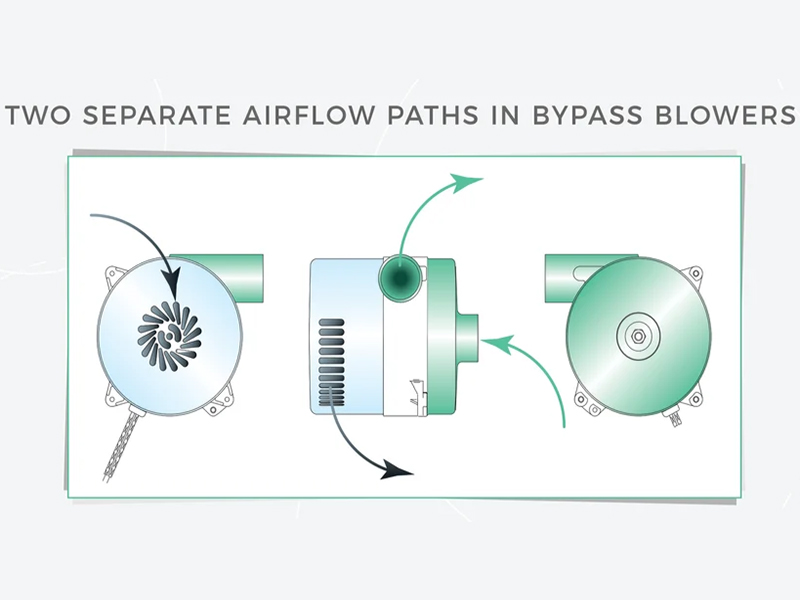 In bypass motors, the working air is independent from the cooling air. A separate fan directly cools the motor windings and electronics. Usually, the cooling air enters and exits through slots in the equipment housing or other designed pathway.
 This is in contrast to a through-flow motor where the same air that is performing work by vacuum or pressure also cools the motor parts.
Bypass motors, are electric-motor-driven blowers that segregate two paths of air:
• Working Air: The path of air for performing the application’s blowing or vacuum function.
• Cooling Air: The path of air to cool the blower’s motor during operation.
What’s the difference between a bypass blower and a bypass motor?
There is no difference between a bypass blower and a bypass motor. The bypass motor terminology is common in industries where it’s understood that the overall motor-driven design serves a blower function. In fact, Bypass blowers are made in both brushed and brushless motor designs, as the need for air separation is independent of other design variations. Bison Windjammer®, Lamb® and Nautilair® products all come in bypass designs to serve various applications requiring the prevention of air mixing.Bypass Blower Benefits
• Cooling air separation allows higher performance and cooler working-air temperature as well as cleaner air through the motor space.• There is dedicated airflow to the motor and drive and improved thermal management so the blowers can output higher torque-speed values.
• The blowers run at cooler temperatures, which extends the life of the blower.
• Because Bypass cooling air is separate from working air, it is not likely to be restricted and cause overheating of the motor parts. This often requires thermal protection devices in through-flow motors that may not be required in bypasses
More specifically, bypass blowers may be the only choice where industrial, HVAC, and appliance applications need cool working air. In applications with demanding duty cycles, blowers can generate significant heat. If this heat is insufficiently shed, temperatures can quickly rise and cause premature blower shutdown.
Bypass blowers excel where the working air threatens to contaminate or wet the motor and its electronics
Bypass blowers are also indispensable wherever working air has contaminants that threaten to accumulate on the motor-controller electronics within the blower. This contamination can cause electrical short circuits, failure by overheating, and possible safety concerns. Consider the extreme case of blowers in floor-cleaning equipment. Here, bypass blowers allow for scrubber and carpet-extraction functions that involve the vacuuming of moist air and debris. Although designed to be filtered, moist air can destroy bearings and can cause ground faults.

What’s the difference between a peripheral and a tangential exhaust blower?
Peripheral blowers and tangential blowers are two different subtypes of bypass motors which differ in how the air exits the motor.Peripheral bypass blowers deliver diffuse air discharge — undirected into the environment or chamber being treated. On a typical peripheral bypass blower, instead of a tube or horn for air discharge, there are small louvers on the circumference of the cylinder itself. Instead of being directed out, air exits as if it’s leaking out of the cylinder.
Peripheral bypass blowers are useful where focused output air direction is unimportant. One advantage is that the design is relatively compact, especially useful in designs or tight enclosures with geometry that can’t accommodate tubes or other air-routing components.
In contrast, tangential-bypass blowers include a horn to force air to exit the blower in a direction perpendicular to the air inlet direction.
Most blower applications use tangential bypass blowers because they allow designers to route blower output to specific directions, or even out through a tube. For the latter, designs often include a round output tube onto which a hose can mount to for routing of discharge air for specific functions within a machine or environment.
Bison bypass blowers come in both brushed and brushless designs with peripheral or tangential outputs and can often be swapped if the controllability and life features of brushless blowers are desired.
Designing a product with bypass motors in mind
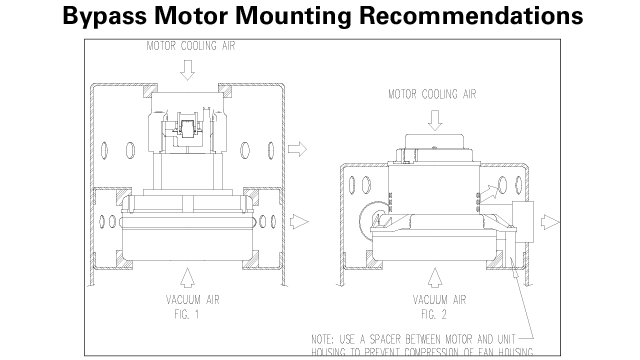
To properly take advantage of bypass characteristics, the product designer must follow a couple of design rules. Failure to do so can lead to early thermal failure.First, the product must be internally baffled to prevent the cooling exhaust air from recirculating back into the inlet ports. It must be directed to the outside of the motor. Recirculated air heats up through repeated passages over the windings. It should also be prevented from recirculating to the inlet side once outside of the motor.
Secondly, the working air exhaust must be prevented from circulating through either the inlet or exhaust cooling ports. Working air is at a higher pressure and can overwhelm the designed cooling air flow.
Proper attention to these two guidelines will ensure a successful installation.

Engage with our engineers, locate an authorized distributor or connect with customer and technical support.